You’re in. Your guide is downloading.
The Movember Real Conversations® Guide should be downloading now. A copy is also on its way to your inbox; if it isn’t there in a couple of minutes, check your junk folder and add us to your safe senders, because the twenty skills will come from the same address. Read pages 10 to 13 first: that’s your rollout kit. Send the launch email on Friday 30 October. Your first skill lands Monday 2 November at 7:30am.
Know another HR or people lead who owns November? Send them this page.
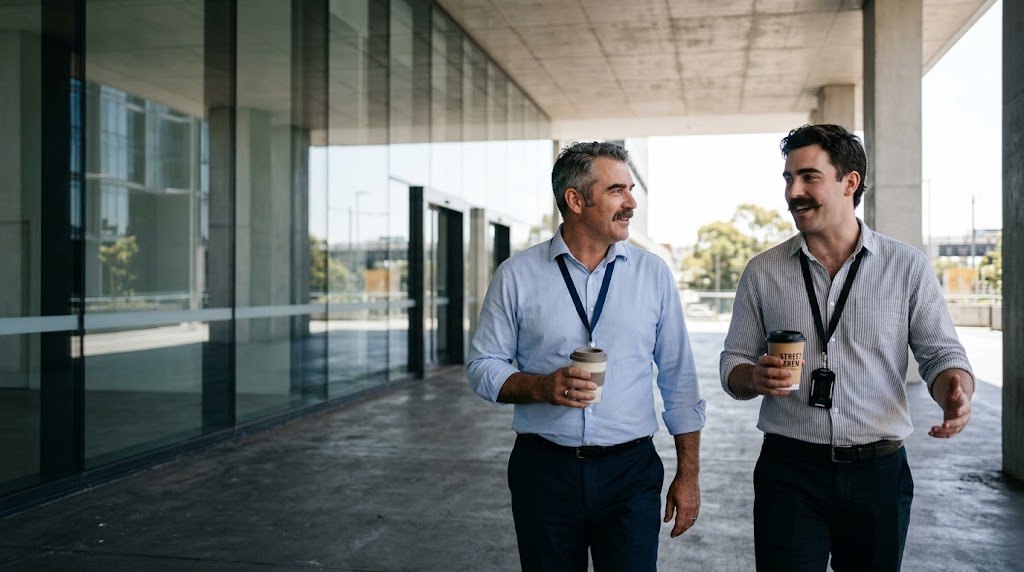
For the person who owns November at work.
The moustache gets men talking. These twenty skills teach your team what to do next.
Twenty years of awareness aimed at men hasn’t changed what men do when they’re not OK. Four hours of training the people around them cut work-related sick leave by 18 per cent in a randomised trial. This is the light version of that: by 27 November your managers will know what to do when a man says he’s not fine, and you won’t have written a word of it.
You’ve run Movember before. You know how it goes.
The moustaches come out. Someone sets up a leaderboard. A man from the leadership team records something honest on his phone. Participation is good. The men nod.
Then nothing changes.
The bloke who’s been short with everyone since August is still short with everyone.
The reliable one who started dropping things is still dropping things.
The one who joked about being done, and nobody laughed properly, is still joking.
of men agree men should feel comfortable asking for help.
still believe real strength means pushing through without complaining.
Every man in your workplace thinks he’s the only one holding the second view. That’s the gap, and no poster closes it.
That’s not a participation problem. It’s a capability problem. This November, closing it costs you one paste a day.
Movember, The Real Face of Men’s Health 2025 (n = 4,126, US)
One email. Three parts. Under a minute to send.
7:30am, every working day from Monday 2 November. The skill lands before your day starts.
You paste one block. Each email has a post already written as you or a manager speaking to the team, plus the tile image. Slack, Teams, the site group chat, the internal newsletter. Wherever your men actually are.
Twenty days, then we stop. Four weeks, one stage of the conversation per week: how to start with a man, how to hear what he’s not saying, how to hold the heavy ones, how to help without carrying it home.
That’s one of twenty. You never write a word. You choose where it goes.
The month, day by day. Titles now. Skills daily.
Here’s what’s coming. The titles are the hook; the skill inside each one arrives on its day. Print this and you can see the end of the month from the start of it.
Every one of these comes from the Real Conversations® framework, trained inside 200 plus organisations on four continents, angled for how men actually show up when they’re not OK.
Start the MonthThe field has worked out how to get men’s attention. It hasn’t worked out what happens next.
29% up.
Four hours of training managers to notice and hold a mental health conversation, in a randomised trial inside Fire and Rescue NSW. Work-related sick leave fell 18% under trained managers and rose 29% under untrained ones. Return on investment: roughly ten to one.
Milligan-Saville et al., The Lancet Psychiatry, 2017One exposure to a help-seeking music video made for men moved nothing between groups in a randomised trial of 476 Australian men.
Nicholas et al., BMC Public Health, 2025A humour-led men’s mental health platform with serious engagement numbers produced no symptom benefit over control in its randomised trial. Attention, yes. Change, no.
Frey et al., 2023Read those three together. The intervention that moved a hard outcome didn’t retrain the men. It trained the people men talk to. The campaigns aimed at men’s awareness got attention and stopped there. That’s the whole idea behind this month. Twenty days of capability in the hands of the people around him, instead of one more poster aimed at him.
“Awareness gets the ask. Capability decides what the ask becomes.”
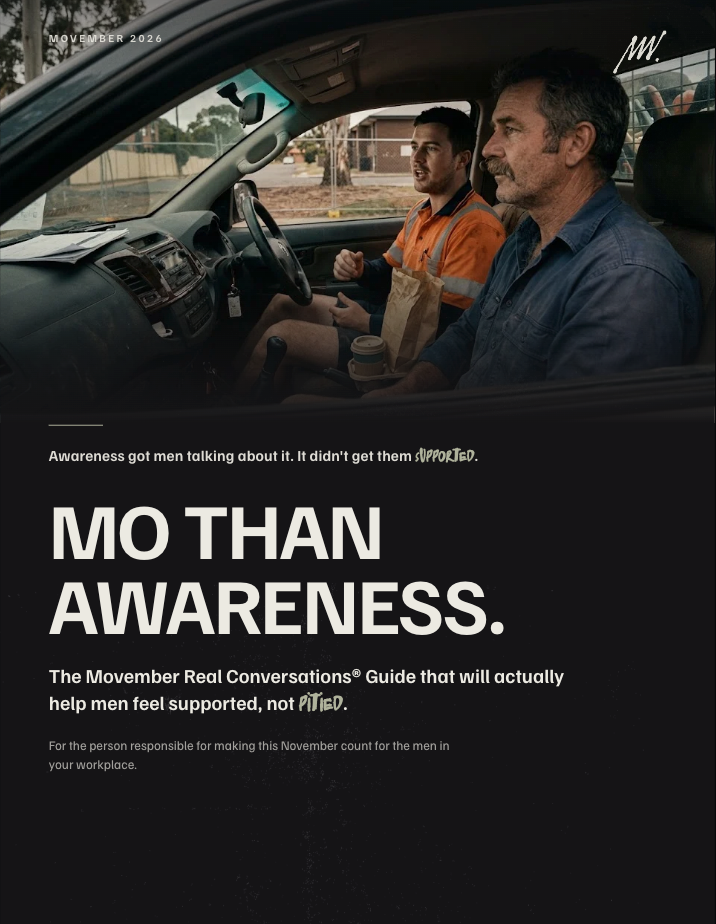 The Movember Real Conversations® Guide · 16 pages
First, the guide. So you can set the month up before it starts.
The month is the thing. The guide is how you run it. It lands the moment you sign up, and it’s built to be forwarded to a leadership team without a covering note.
The gap in one page. Eight verified numbers on men and help-seeking, Australian data first, with the nuance that keeps them honest. Sources printed on the page.
Why men engage differently. The five conditions that decide whether a man accepts support, from the most cited paper in the field.
Seven differences worth building on, and seven myths your managers will hear at the barbecue. Two tables. Precise enough to survive anyone checking.
The male mask. Seven ways a man says “I’m not OK” without saying it, each with the line to say back. Printable. Your managers will screenshot it.
The calendar. All twenty skills at a glance, so you can see the month before it happens.
The rollout kit. A staff launch email for Friday 30 October, a manager briefing note, the International Men’s Day plan and four weekly posts. Written in your voice. Swap the brackets and send.
The escalation map. The three-gate protocol for serious disclosures, in plain English your WHS lead will sign off.
Sixteen pages. No theory. Built for the person who has to make November count.
The people men talk to are half your workforce. Probably more.
Men route disclosure to the women in their lives. In the past week, 30 per cent of men had shared feelings with a friend, against 48 per cent of women, and men were half as likely to have received emotional support from one. So the person a man opens up to at work is as likely to be the woman two desks over as the bloke he has lunch with. This month is for both.
You lead people, and at least one of them is a man you’ve quietly worried about since August.
You’re the one people come to. Not because it’s your job. Because you’re safe.
You have a mate, a brother, a dad or a partner you’d like to be better for, and you’d rather learn on a Tuesday morning than in a crisis.
Survey Center on American Life 2021 (US) · Dindia and Allen 1992
A psychology thought leader who teaches connection as a capability. Not a wellbeing speaker.
Mitch Wallis holds a Masters in Psychology from Columbia University, spent seven years at Microsoft as a Global Product Manager, and founded Heart On My Sleeve, a nationally recognised suicide prevention movement. He has trained 10,000 plus leaders across four continents inside 200 plus organisations including KPMG, Lendlease, Allianz, Suncorp, Microsoft, Deloitte, Johnson & Johnson and JP Morgan. Named GQ Man of Impact. UN advisor on youth mental health.
He has also lived with OCD, anxiety and depression for more than 20 years. He knows what it is to be a man who is fluent in fine. The work isn’t theoretical for him. It’s a translation of what he learned the hard way into something that can be taught at scale, to the people men actually talk to.
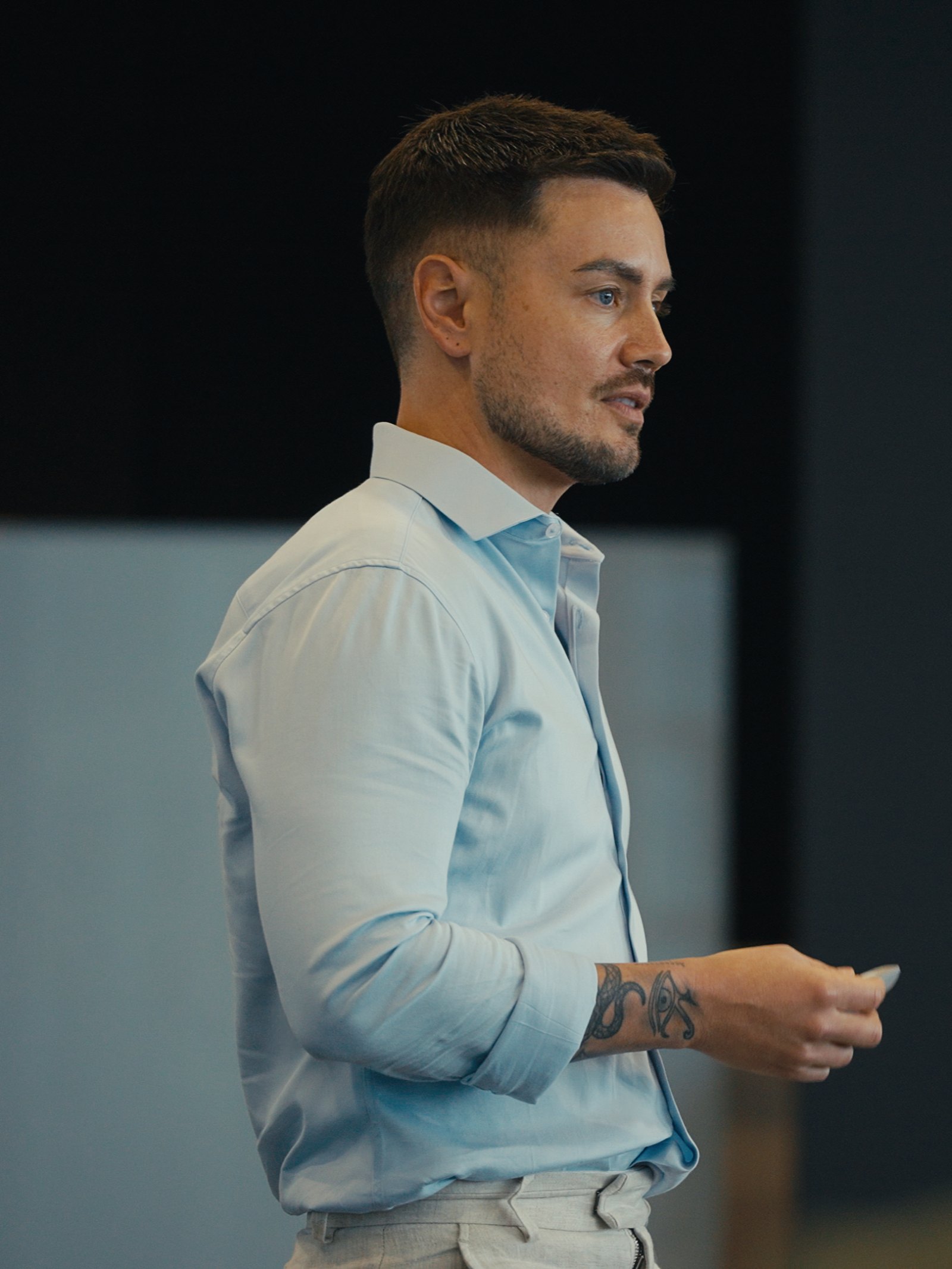
The twenty days are free. The day that makes them stick isn’t.
Most workplaces will run Movember this year the way they always have. A handful will open it with a keynote that gives every person in the building the same five moves for the moment a man says he’s not fine, then run the twenty days to make them habit. That’s the version that changes something, and it’s why organisations book Mitch for a calendar moment and keep him long after it. Limited November keynote dates left, in person or virtual. International Men’s Day is Thursday 19 November.
Worst case: you leave with a sharper Movember plan, whether we deliver it or not.
Check Mitch’s November AvailabilityThe bravest thing a man in your workplace does this year might take four seconds. What your people do next decides whether he ever does it twice.
Twenty skills. One a day. Ready to send. Start before Monday 2 November.
Check Mitch’s November availability → A Real Conversations® campaign by Mitch Wallis · Masters in Psychology from Columbia University · mitchwallis.com
If you or someone you know needs support now: Lifeline 13 11 14 · MensLine Australia 1300 78 99 78 · 13YARN 13 92 76 · Emergency 000